Tempered Glass
Tempered or toughened glass is a type of safety glass processed by controlled thermal or chemical treatments to increase its strength compared with normal glass. Tempering puts the outer surfaces into compression and the interior into tension. Such stresses cause the glass, when broken, to shatter into small granular chunks instead of splintering into jagged shards as ordinary annealed glass does. The granular chunks are less likely to cause injury.
The glass is used for its safety and strength in a variety of applications, including passenger vehicle windows, shower doors, aquariums, architectural glass doors and tables, refrigerator trays, mobile phone screen protectors, bulletproof glass components, diving masks, and plates and cookware.
Manufacturing
Tempered glass can be made from annealed glass via a thermal tempering process. The glass is placed onto a roller table, taking it through a furnace that heats it well above its transition temperature of 564 °C (1,047 °F) to around 620 °C (1,148 °F). The glass is then rapidly cooled with forced air drafts while the inner portion remains free to flow for a short time.
An alternative chemical toughening process involves forcing a surface layer of glass at least 0.1 mm thick into compression by ion exchange of the sodium ions in the glass surface with potassium ions (which are 30% larger), by immersion of the glass into a bath of molten potassium nitrate. Chemical toughening results in increased toughness compared with thermal tempering and can be applied to glass objects of complex shapes.
Properties
Tempered glass is about four times stronger than annealed glass. The greater contraction of the inner layer during manufacturing induces compressive stresses in the surface of the glass balanced by tensile stresses in the body of the glass. Fully tempered 6-mm thick glass must have either a minimum surface compression of 69 MPa (10 000 psi) or an edge compression of not less than 67 MPa (9 700 psi). For it to be considered safety glass, the surface compressive stress should exceed 100 megapascals (15,000 psi). As a result of the increased surface stress, when broken the glass breaks into small rounded chunks as opposed to sharp jagged shards.
Compressive surface stresses give tempered glass increased strength. Annealed glass has almost no internal stress and usually forms microscopic cracks on its surface. Tension applied to the glass can drive crack propagation which, once begun, concentrates tension at the tip of the crack driving crack propagation at the speed of sound through the glass. Consequently, annealed glass is fragile and breaks into irregular and sharp pieces. The compressive stresses on the surface of tempered glass contain flaws, preventing their propagation or expansion.
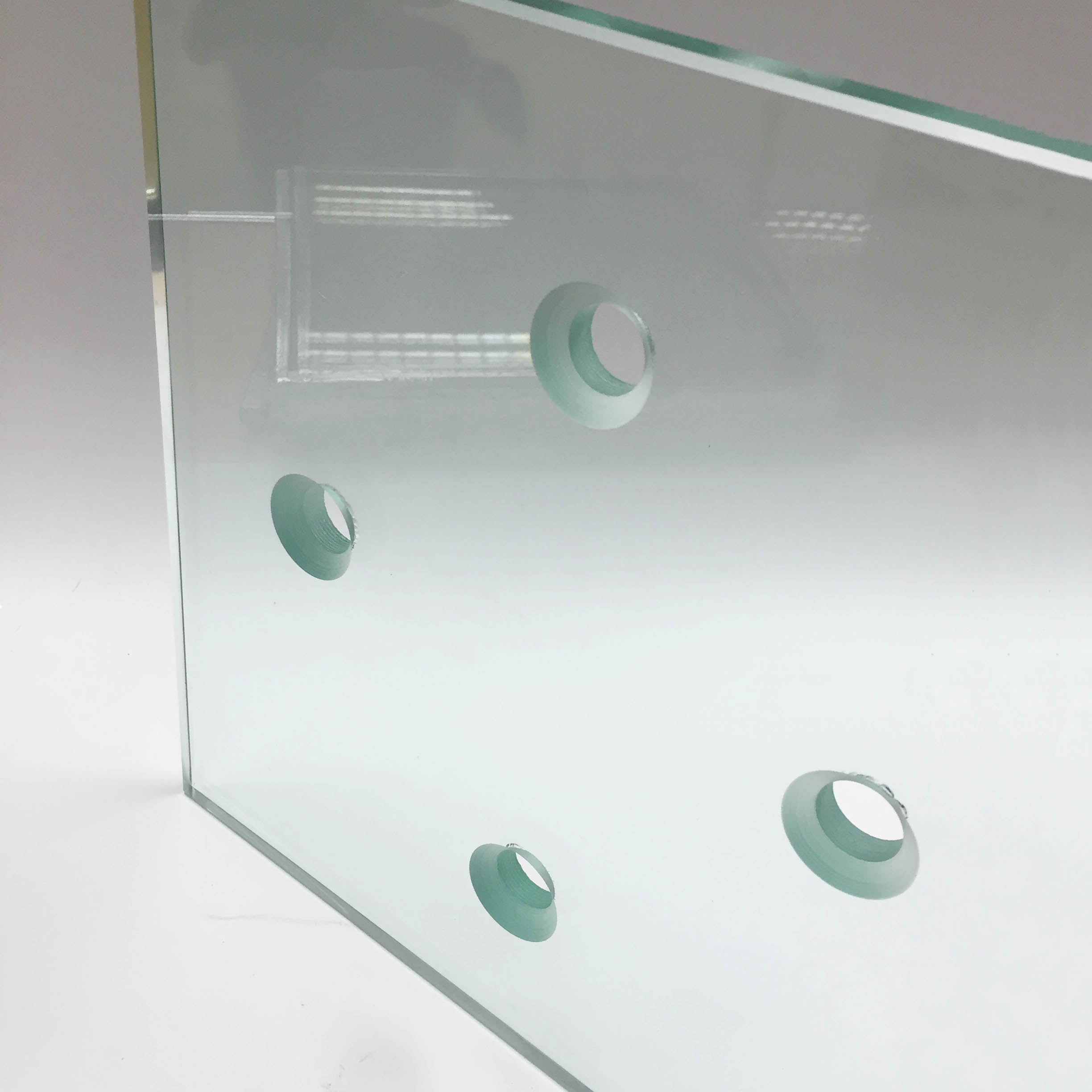
Any cutting or grinding must be done prior to tempering. Cutting, grinding, and sharp impacts after tempering will cause the glass to fracture.
The strain pattern resulting from tempering can be observed by viewing through an optical polarizer, such as a pair of polarizing sunglasses.
Disadvantages
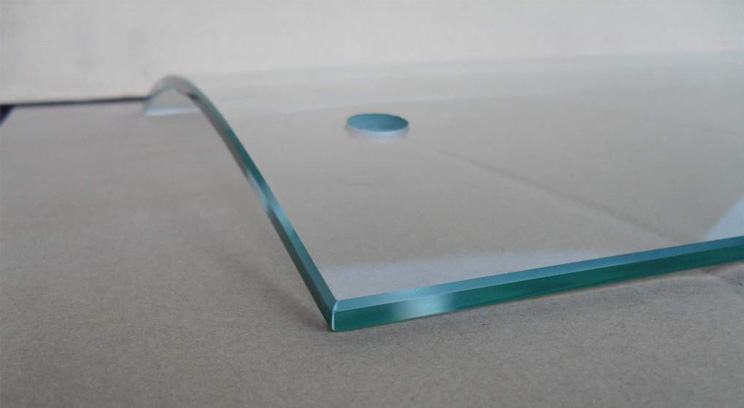
Tempered glass must be cut to size or pressed to shape before tempering, and cannot be re-worked once tempered. Polishing the edges or drilling holes in the glass is carried out before the tempering process starts. Because of the balanced stresses in the glass, damage to any portion will eventually result in the glass shattering into thumbnail-sized pieces. The glass is most susceptible to breakage due to damage at its edge, where the tensile stress is the greatest, but can also shatter in the event of a hard impact in the middle of the glass pane or if the impact is concentrated (for example, the glass is struck with a hardened point).
Using tempered glass can pose a security risk in some situations because of the tendency of the glass to shatter completely upon hard impact rather than leaving shards in the window frame.
The surface of tempered glass does exhibit surface waves caused by contact with flattening rollers if it has been formed using this process. This waviness is a significant problem in the manufacturing of thin-film solar cells. The float glass process can be used to provide low-distortion sheets with very flat and parallel surfaces as an alternative for different glazing applications.
Nickel sulfide defects can cause spontaneous breakage of tempered glass years after its manufacturing.
Uses
Tempered glass is used when strength, thermal resistance, and safety are important considerations. Passenger vehicles, for example, have all three requirements. Since they are stored outdoors, they are subject to constant heating and cooling as well as dramatic temperature changes throughout the year. Moreover, they must withstand small impacts from road debris such as stones as well as road accidents. Because large, sharp glass shards would present an additional and unacceptable danger to passengers, tempered glass is used so that if broken, the pieces are blunt and mostly harmless. The windscreen or windshield is instead made of laminated glass, which will not shatter into pieces when broken while side windows and the rear windshield have historically been made of tempered glass. Some newer luxury vehicles have laminated side windows to meet occupancy retention regulations, anti-theft purposes, or sound-deadening purposes.
Other typical applications of tempered glass include:
- Balcony doors
- Athletic facilities
- Swimming pools
- Façades
- Shower doors and bathroom areas
- Exhibition areas and displays
- Computer towers or cases
- Mobile phone screen protectors
Buildings and structures
Tempered glass is also used in buildings for unframed assemblies (such as frameless glass doors), structurally loaded applications, and any other application that would become dangerous in the event of human impact. Building codes in the United States require tempered or laminated glass in several situations including some skylights, glass installed near doorways and stairways, large windows, windows which extend close to floor level, sliding doors, elevators, fire department access panels, and glass installed near swimming pools.
Household uses
Tempered glass is also used in the home. Some common household furniture and appliances that use tempered glass are frameless shower doors, glass tabletops, glass shelves, cabinet glass, and glass for fireplaces.
Cooking and baking
Some forms of tempered glass are used for cooking and baking. This is also the type of glass used for oven doors.
Touchscreen devices
Most touchscreen mobile devices use some form of toughened glass but there are also separate tempered screen protectors for touchscreen devices sold as an accessory.